Heat and Sun on Safari: Avoiding Heat Exhaustion in East Africa
Game drives run through the heat of the day. Many first-time safari travellers underestimate the sun at altitude and end up spending their second afternoon in camp instead of in the field. This guide explains what to watch for and how to stay comfortable.
Medical review pending.
Professor of Public Health, David Tvildiani Medical University · Chair, Public Health Institute of Georgia · WHO Consultant, Health & Migration · Editor-in-Chief, Georgian Medical Journal
Ⓐ ORCID: 0000-0001-7609-4515
Produced in partnership with GMJ Newsroom and peer-reviewed by the GMJ editorial board.
East Africa’s equatorial sun is intense. The Masai Mara sits at 1,500 to 2,000 metres above sea level — high enough to reduce humidity, but not high enough to significantly weaken UV radiation [1]. Combine four to six hours in an open vehicle with the reflective light off the grass plains and it is easy to understand why heat-related illness is one of the most common medical complaints among first-time safari travellers.
Understanding the Difference
Heat exhaustion develops when the body loses fluid and salt faster than it replaces them. Symptoms include heavy sweating, cool and pale skin, rapid pulse, nausea, weakness and muscle cramps [2]. It is serious but responds quickly to rest, shade and fluid replacement.
Heat stroke occurs when the body’s temperature regulation fails. Skin becomes hot, red and dry. Confusion, slurred speech and loss of consciousness follow [2]. Heat stroke is a medical emergency requiring immediate hospital treatment. Mortality from untreated heat stroke exceeds 50% [3].
The line between the two is crossed faster than most people expect, particularly in travellers who are jet-lagged, slightly dehydrated from the flight, and not yet acclimatised [4].
Prevention: The Practical Steps
Hydration: The WHO recommends fluid replacement of approximately 500 ml per hour during physical activity in hot environments [5]. Drink one litre of water per hour during game drives in the heat of the day. Carry your own water bottle in the vehicle. Do not rely on camp supplies being available at all stops.
Sun protection: SPF 50 sunscreen applied before the morning drive and reapplied at the midday game stop [1]. A wide-brimmed hat is not optional — it is essential. Many travellers also use a lightweight scarf to protect the neck and upper back.
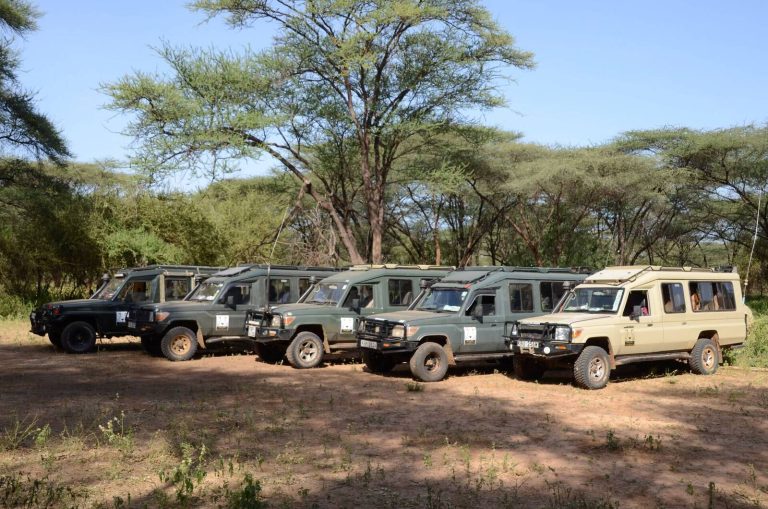
Clothing: Light-coloured, long-sleeved shirts made of breathable linen or technical fabric are cooler than T-shirts, which leave the arms exposed. Dark colours absorb heat; khaki and tan reflect it [6].
Timing: The worst heat is between 12:00 and 14:00. Many camps structure drives to return before midday and head out again at 16:00. Use the midday break properly — rest in shade or air conditioning, eat lightly, and drink.
Recognising a Problem Early
A headache during a game drive, combined with reduced urination or dark urine when you return to camp, means you are dehydrated [7]. Stop, drink, rest. Tell your guide. Do not push through a full afternoon drive if you feel unwell — you will feel worse by sunset.
Every Africa Calling vehicle carries a first-aid kit and emergency contact protocols. Our guides are trained in wilderness first response. Contact us for any pre-travel health questions.
About the Authors

Prof. Giorgi Pkhakadze, MD MPH PhD
Medical Reviewer & Co-Author
Professor of Public Health at David Tvildiani Medical University, Tbilisi. Chair, Public Health Institute of Georgia. WHO Consultant, Health & Migration. Editor-in-Chief, Georgian Medical Journal. Former principal public health adviser to the Prime Minister of Georgia (COVID-19 pandemic, 2020–2022).
Managing Director, Africa Calling Safaris
With over two decades of experience planning private safaris across Kenya, Tanzania and Uganda, Nikos has guided guests from more than 40 countries through East Africa’s wilderness. He brings on-the-ground expertise to the Africa Calling Safari News health series, produced in partnership with the Georgian Medical Journal.
References
- World Health Organization. Global Solar UV Index: A Practical Guide. Geneva: WHO/UNEP/WMO/ICNIRP; 2002. Available from: https://www.who.int/publications/i/item/9241590076
- Bouchama A, Knochel JP. Heat stroke. N Engl J Med. 2002;346(25):1978–1988. doi:10.1056/NEJMra011089
- Leon LR, Bouchama A. Heat stroke. Compr Physiol. 2015;5(2):611–647. doi:10.1002/cphy.c140017
- Goedecke JH, Gibson ASC, Grobler L, Collins M, Noakes TD, Lambert EV. Determinants of exercise-induced fluid loss. Clin Sports Med. 2005;24(1):1–17.
- World Health Organization. Heat and Health. WHO Factsheet. Geneva: WHO; 2018. Available from: https://www.who.int/news-room/fact-sheets/detail/climate-change-heat-and-health
- National Institute for Occupational Safety and Health (NIOSH). Occupational Exposure to Heat and Hot Environments. Cincinnati: NIOSH; 2016. NIOSH Publication No. 2016-106.
- Armstrong LE, Maresh CM, Castellani JW, et al. Urinary indices of hydration status. Int J Sport Nutr. 1994;4(3):265–279. doi:10.1123/ijsn.4.3.265
This article is general health information for travellers, not personal medical advice. Rules on vaccinations and malaria prevention change; check with your own doctor or a travel clinic 6–8 weeks before you travel.
More from Safari News
All stories-
Safari Health
Safari Health Checklist: 7 Questions Answered by a Doctor and a Guide
Vaccines, malaria, food and water, sun, altitude, chronic conditions and insurance: evidence-based safari health advice from a doctor and a guide.
-
Safari Health
Safari Medical Kit: 12 Items Every Traveller Should Pack
Bush camps are remote. The nearest pharmacy may be three hours away. A compact personal medical kit handles the everyday issues that can derail a safari if you are unprepared.
-
Safari Health
Safari Vaccinations: What You Actually Need Before You Go
Not every vaccine listed online applies to every itinerary. This guide explains which vaccinations are genuinely recommended for East African safari travel, which are legally required and which are optional.