Flamingo Season at Lake Nakuru: A Pink Spectacle You Cannot Miss
Lake Nakuru in Kenya's Rift Valley has hosted up to two million flamingos at a time. Here is when to visit, what has changed, and what else you will see in this compact national park.
Lake Nakuru’s flamingo spectacle is one of the most photographed wildlife scenes in East Africa. BBC Earth’s bird habitat profiles explain how the convergence of Afrotropical and Palearctic migratory routes makes Kenya one of the most productive birding destinations on the continent. Lake Nakuru’s flamingo spectacle is one of the most photographed wildlife scenes in Africa. At peak periods, hundreds of thousands of lesser flamingos line the lake’s alkaline shallows in dense pink bands, creating a sight so improbable it looks manipulated. The lake is one of the world’s most productive algae systems, making it a permanent food source for flamingo populations across the Rift Valley.
Key Facts
- Lesser flamingo (Phoeniconaias minor) filters Arthrospira algae using up to 10,000 lamellae per half-beak, consuming approximately 60 g of dry algae per day
- Lake Nakuru has a pH of approximately 10.5 — highly alkaline — supporting dense blue-green algae blooms unsuitable for most vertebrates but ideal for flamingos
- The lake was designated a Ramsar Wetland of International Importance in 1990
- Lake Nakuru National Park (188 km²) is fully fenced and holds both black (Diceros bicornis) and white (Ceratotherium simum) rhino
- A 2012–2013 flooding event raised water levels by approximately 4 m, reducing algae blooms and temporarily displacing the majority of the flamingo population
Why Flamingos Come Here
Lake Nakuru is an alkaline, saline lake fed by freshwater springs. The alkalinity supports dense blooms of a blue-green alga called Arthrospira (formerly Spirulina). Lesser flamingos — the smaller, pinker species — filter this alga directly from the water using specialised lamellae in their beaks. Greater flamingos, which are taller and paler, feed on invertebrates in the shallow mud. Both species are present year-round, though numbers fluctuate seasonally.
When to Visit
The largest concentrations occur during the dry seasons (January to February and July to October) when water levels drop and algae blooms intensify. However, since a flooding event in 2012 raised water levels significantly and temporarily displaced much of the population, flamingo numbers at Nakuru have been more variable. Hundreds of thousands remain, but the multi-million flocks of earlier decades are less frequent.
Beyond the Flamingos
Lake Nakuru National Park is a fenced reserve covering 188 square kilometres. It holds one of Kenya’s strongest rhino populations — both black and white rhino — which were reintroduced after the species was poached to local extinction in the 1980s. Lion, leopard, waterbuck, buffalo and Rothschild’s giraffe (one of the tallest giraffe subspecies) are all present. The park is small enough to cover thoroughly in a single full-day game drive.
Nakuru is a three-hour drive from Nairobi and pairs naturally with Lake Naivasha or a Mara safari. Africa Calling includes it as a recommended stop on longer Rift Valley circuits. Ask us about current flamingo numbers before you plan your visit.
The Rhino Connection and Why Nakuru Matters for Conservation
Lake Nakuru National Park’s fenced perimeter — established in the 1980s primarily to protect rhinos — makes it one of Kenya’s most secure breeding areas for both black and white rhino. The Save the Rhino charity records Nakuru as a key node in Kenya’s national rhino recovery strategy, contributing breeding animals to translocation programmes at new conservancies. Visitor fees at Nakuru flow directly to the Kenya Wildlife Service ranger force responsible for protecting this population.
The park’s concentrated wildlife and compact size make it well-suited to a half-day or full-day game drive as part of a Rift Valley circuit rather than a standalone destination. Most visitors combine Nakuru with Lake Naivasha to the south — famous for hippos and the largest freshwater lake in the Rift Valley — and the longer journey north toward Samburu. Our guide to rhino conservation in Kenya provides important context for understanding what is at stake at Nakuru and Ol Pejeta. For the wider ecosystem these species inhabit, see our piece on Ol Pejeta Conservancy.
The Kenya Wildlife Service manages Lake Nakuru National Park and provides current entry fee information and visitor regulations on its website. Entry is electronic through the e-citizen platform; Africa Calling handles all park fee payments as part of guided itineraries, so visitors arrive without queuing at the gate.
Planning Your Nakuru Visit
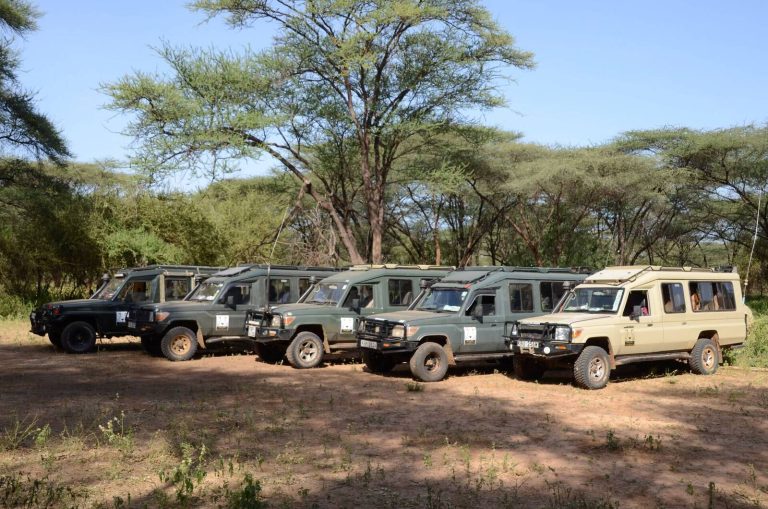
Lake Nakuru National Park is a three-hour drive from Nairobi via the A104 highway. It is compact enough to be covered in a single full-day game drive, making it practical as a one-night addition to a Nairobi-Mara itinerary or as a standalone overnight trip from the capital. The park gate opens at 6:00 a.m.; arriving by 6:30 a.m. gives access to the best morning light on the lake’s flamingo shallows. The Kenya Wildlife Service handles entry through the eCitizen platform; Africa Calling manages all park fee payments for guided guests. Accommodation inside the park ranges from Kenya Wildlife Service cottages to mid-range lodges on the lake’s edge. For guests combining Nakuru with the Masai Mara, our seasonal timing guide advises on the most efficient routing, and the rhino conservation guide provides full context on the park’s significance beyond the flamingo spectacle.
Sources and Further Reading
- Terer, T. et al. (2012). Effect of water level fluctuations on the distribution of birds in the littoral zone of Lake Nakuru, Kenya. Hydrobiologia, 680(1), 155–167.
- Ramsar Convention Secretariat. Ramsar Sites Information Service: Lake Nakuru. rsis.ramsar.org
- Kenya Wildlife Service. Lake Nakuru National Park. kws.go.ke
- Save the Rhino International. Kenya rhino population data. savetherhino.org
About the Author

Managing Director, Africa Calling Safaris · Editor, Safari News
Over two decades designing private safari journeys across Kenya, Tanzania and Uganda. Full profile →
More from Safari News
All stories-
Sightings & Migration
Night Drives in Samburu: What You See After Dark
Night game drives are not permitted in Kenya's national parks — but they are in Samburu's private conservancies. Here is what changes after dark and which nocturnal species you have a genuine…
-
Sightings & Migration
Following the Elephants: Amboseli’s Giant Families Explained
Amboseli National Park offers Africa's best elephant viewing, with over 1,600 individually identified animals. Here is what makes this ecosystem extraordinary and how to make the most of a visit.
-
Sightings & Migration
Kenya’s Big Cats: Where to Find Lions, Leopards and Cheetahs
Kenya holds some of Africa's highest concentrations of big cats. This guide breaks down where each species is most reliably seen and what time of year gives you the best odds.