Kenya’s Big Cats: Where to Find Lions, Leopards and Cheetahs
Kenya holds some of Africa's highest concentrations of big cats. This guide breaks down where each species is most reliably seen and what time of year gives you the best odds.
Kenya is one of the few places on Earth where you can see all three big cats. The BBC’s Big Cat Diary, filmed in the Masai Mara from 1996, introduced television audiences worldwide to the individual personalities of resident lions, leopards and cheetahs — a series whose legacy endures in the guides who grew up watching it. BBC Earth’s ongoing big cat documentary work provides excellent context for understanding territorial behaviour before your visit. Kenya is one of the few places on Earth where you can see all three big cats — lion, leopard and cheetah — in a single safari. Each species favours different habitat, hunts at different times and requires a different strategy to find.
Key Facts
- Kenya holds approximately 2,000–2,500 lions; the greater Masai Mara ecosystem alone supports an estimated 800+ individuals
- Global cheetah (Acinonyx jubatus) population: approximately 7,100 adults (IUCN, 2022); Kenya holds roughly 900
- Leopard (Panthera pardus) is classified Vulnerable on the IUCN Red List (2016 assessment)
- A cheetah can reach 100 km/h within three seconds — the fastest land acceleration of any animal
- Lion hunting success rates for the Mara’s large coalitions run at 26–30%; solo cheetah hunts succeed roughly 50% of the time
Lions: The Masai Mara’s Superabundance
The Masai Mara has one of the highest lion densities anywhere in Africa. The Marsh Pride — made famous by the BBC’s Big Cat Diary — roams the Musiara Marsh area. Male coalitions here often number three or four individuals, which is exceptional.
Lions are most active at dawn and dusk. Full-day game drives that stay out over midday often catch lions hunting in the midday heat, contrary to popular belief. Pride hunts are more frequent during the dry season (July to October) when prey concentrations are highest near permanent water.
Leopards: Samburu and Laikipia
Leopards are solitary, nocturnal and deliberately difficult to find. The best sightings in Kenya come from Samburu National Reserve and the private conservancies of Laikipia Plateau. Guides in these areas know individual leopards by name and territory. Night drives — permitted on private conservancy land — dramatically improve your chances.
Leopards spend daylight hours in dense riverine trees, particularly acacia and fig. Look for a tail hanging from a branch.
Cheetahs: The Mara’s Open Plains
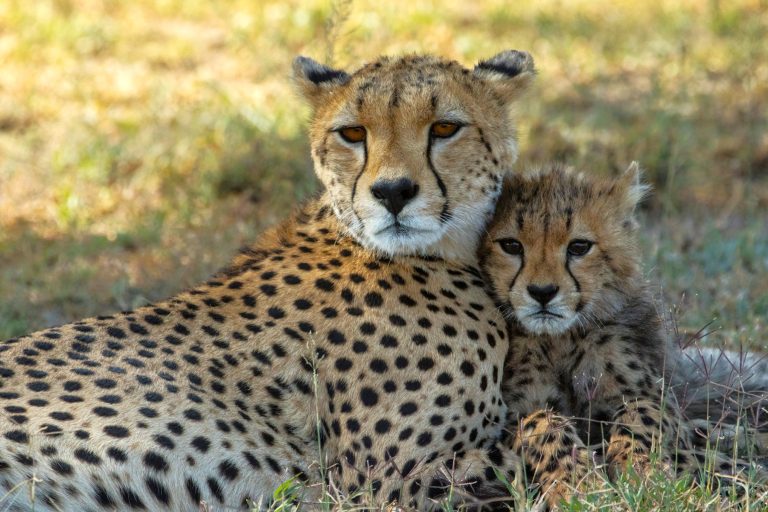
Cheetahs need open ground — they hunt by sight and require a long run. The short-grass plains of the Masai Mara and Amboseli provide ideal habitat. Female cheetahs with cubs are frequently sighted in the central Mara, particularly around the Talek area. A cheetah hunt, from stalk to kill, is over in 30 seconds but is one of the most intense wildlife moments you will witness.
Quick tip: Ask your guide to check whether any known cheetah mothers have cubs. A cheetah mother with three or four cubs, all old enough to observe the hunt, is the most rewarding wildlife experience in Africa.
Africa Calling’s guides carry daily updates from the ranger network. Book a big-cat-focused itinerary and we will structure your game drives around the highest-probability sightings for your dates.
Conservation Status and What It Means on the Ground
All three species face pressures beyond Kenya’s borders, but inside the country’s protected areas they are doing comparatively well. The lion population in the greater Masai Mara ecosystem is estimated at over 800 individuals — one of the world’s densest concentrations outside the Serengeti National Park in Tanzania. Cheetah numbers in Kenya are lower, with the IUCN Red List classifying the species as Vulnerable, primarily due to habitat loss and human-wildlife conflict at reserve boundaries. Leopard are listed as Vulnerable globally; their secretive habits make accurate population counts difficult, but Samburu and Laikipia support healthy breeding populations.
Human-wildlife conflict is the primary threat to all three species outside gazetted parks. Lions and cheetahs that take livestock are frequently killed in retaliation. Community conservancy compensation schemes — funded partly through safari tourism revenues — aim to reduce this pressure by paying herders the market value of any livestock lost to predators within conservancy boundaries. The model has measurable results: lion mortality in the Mara conservancy network decreased by 61 per cent in the five years following the introduction of compensation payments.
Readers interested in how safari tourism funds predator conservation should also read our coverage of the Maasai-wildlife partnership and northern Kenya community conservancies. For planning the drive schedule that maximises big-cat sightings, our month-by-month Kenya guide explains which seasons produce the best predator activity across each ecosystem. The Born Free Foundation publishes accessible science on lion population trends across Africa.
Sources and Further Reading
- Bauer, H. et al. (2015). Lion (Panthera leo) populations are declining rapidly across Africa, except in intensively managed areas. PLOS ONE, 10(12).
- Durant, S. et al. (2017). The global decline of cheetah Acinonyx jubatus and what it means for conservation. Proceedings of the National Academy of Sciences, 114(3), 528–533.
- IUCN SSC Cat Specialist Group (2022). Panthera pardus. IUCN Red List of Threatened Species. iucnredlist.org
- Born Free Foundation. Kenya lion and carnivore conservation updates. bornfree.org.uk
About the Author

Managing Director, Africa Calling Safaris · Editor, Safari News
Over two decades designing private safari journeys across Kenya, Tanzania and Uganda. Full profile →
More from Safari News
All stories-
Sightings & Migration
Night Drives in Samburu: What You See After Dark
Night game drives are not permitted in Kenya's national parks — but they are in Samburu's private conservancies. Here is what changes after dark and which nocturnal species you have a genuine…
-
Sightings & Migration
Flamingo Season at Lake Nakuru: A Pink Spectacle You Cannot Miss
Lake Nakuru in Kenya's Rift Valley has hosted up to two million flamingos at a time. Here is when to visit, what has changed, and what else you will see in this…
-
Sightings & Migration
Following the Elephants: Amboseli’s Giant Families Explained
Amboseli National Park offers Africa's best elephant viewing, with over 1,600 individually identified animals. Here is what makes this ecosystem extraordinary and how to make the most of a visit.