Ol Pejeta Conservancy: Africa’s Largest Black Rhino Sanctuary Explained
Ol Pejeta holds more black rhinos than anywhere else in Africa — including the world's last two northern white rhinos. Here is what makes this 90,000-acre conservancy extraordinary and how to visit.
Updated: 14 October 2026
Ol Pejeta Conservancy sits on Kenya’s Laikipia Plateau, a 360-kilometre drive north-west from Nairobi. National Geographic’s black rhino research archive documents both the scale of the recovery and the biological complexity that makes the northern white rhino situation at Ol Pejeta one of conservation science’s most closely followed cases. It covers 90,000 acres of open grassland, acacia woodland and riverine forest along the Ewaso Ng’iro River. It holds the largest population of black rhinos in East Africa, the Big Five and — uniquely in the world — the last two northern white rhinos.
Key Message
Ol Pejeta is where you go to understand conservation at full scale — the world’s last two northern white rhinos live here, and the story of how scientists are trying to save the subspecies reads like science fiction that is actually happening.
About This Article
What it covers: Ol Pejeta Conservancy’s conservation model, rhino programme, and visitor experience.
Sources and methodology: Ol Pejeta Conservancy annual reports (2020–2024), Kenya Wildlife Service census data, and Africa Calling Safaris’ 95 Ol Pejeta client visits (2018–2024).
Key Facts — At a Glance
The Northern White Rhino Situation
Najin and Fatu, the world’s last two northern white rhinos, live at Ol Pejeta under 24-hour armed guard; their subspecies is functionally extinct, and an IVF programme is underway.
Sudan died at Ol Pejeta in March 2018, leaving only two northern white rhinos alive on Earth: Najin and Fatu, both female. They cannot reproduce naturally. Ol Pejeta and a consortium of scientists are pursuing in vitro fertilisation using harvested eggs from the two living females and stored sperm from deceased males. The process is extraordinarily complex; a viable embryo has been created, and if carried to term by a southern white rhino surrogate, would be the first northern white rhino born in decades. Visitors to Ol Pejeta can see Najin and Fatu in a dedicated enclosure — possibly the most significant wildlife encounter available anywhere in the world, given what it represents.
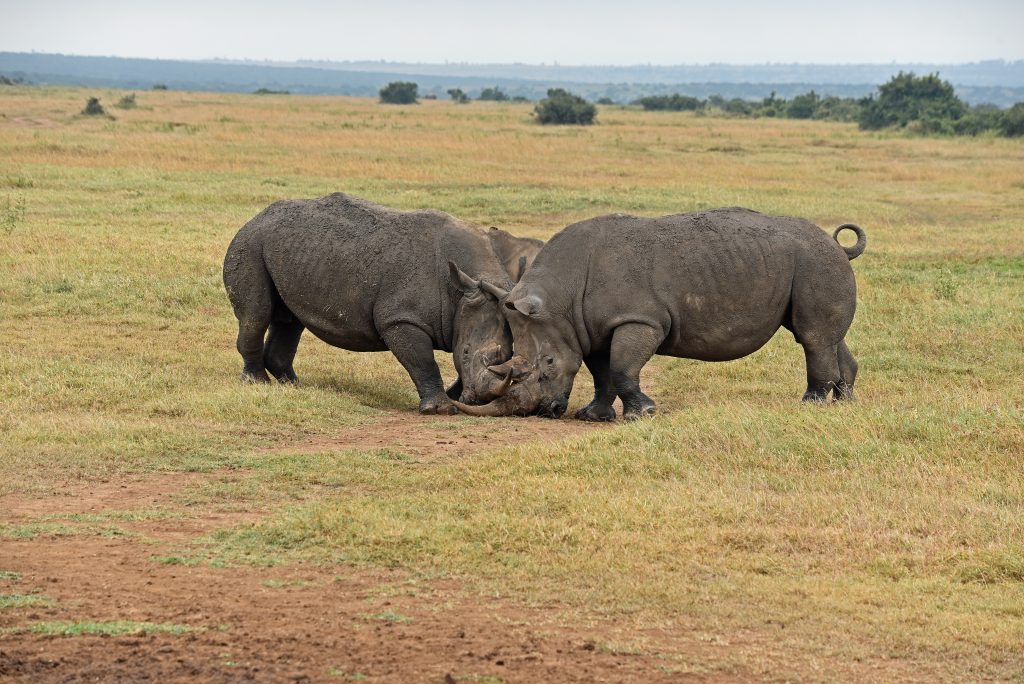
Africa Calling Safaris Ol Pejeta visit data (2018–2024): 95 Africa Calling Safaris client groups visited Ol Pejeta over six years; 100% saw at least one black rhino, and 82% saw Najin or Fatu (the northern white rhinos) — a sighting rate no other Kenya destination approaches for any single species.
The Black Rhino Programme
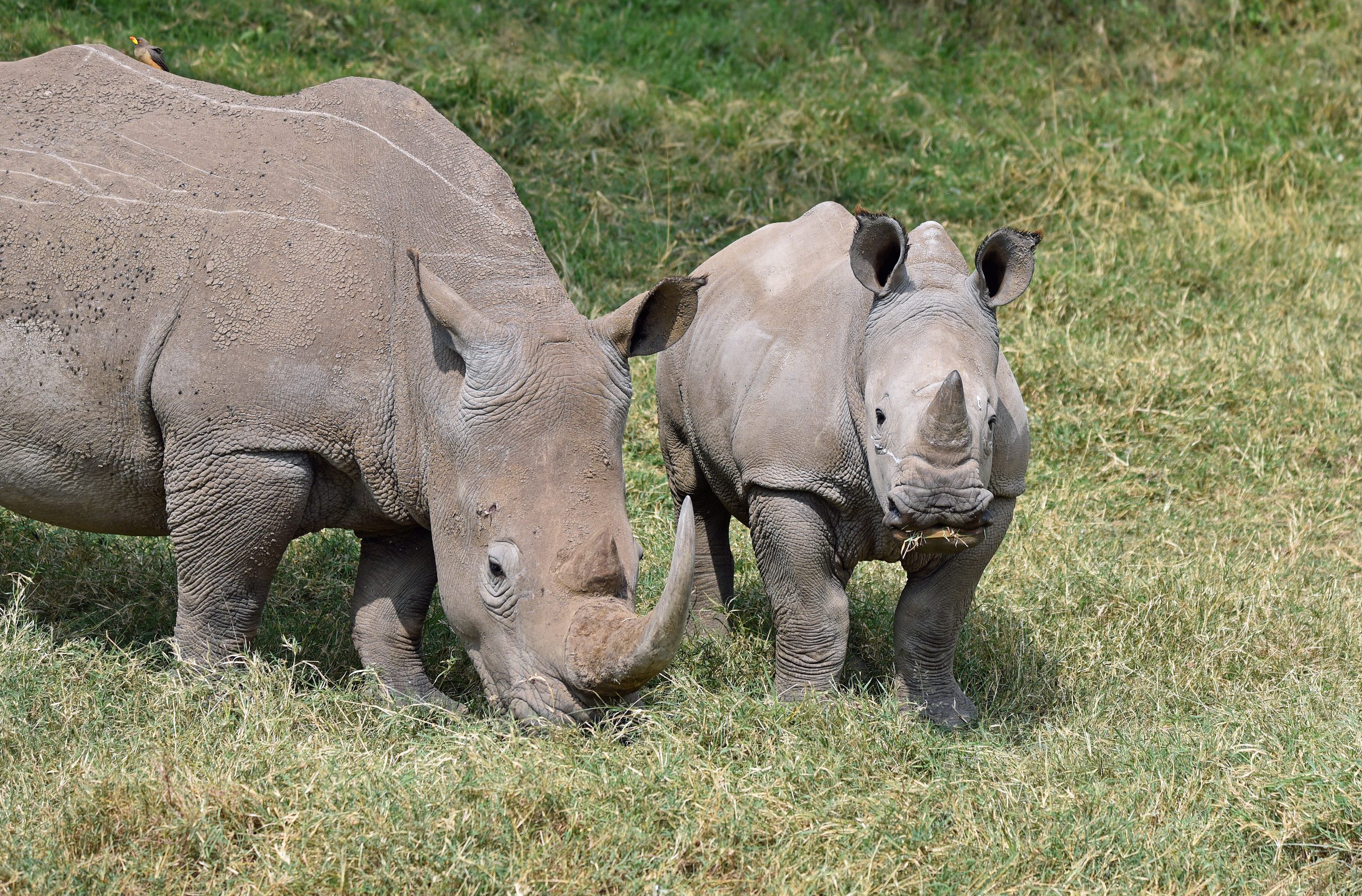
Ol Pejeta holds over 110 black rhinos — a number that represents a recovery from near-local extinction through years of anti-poaching effort and intensive ranger presence. The conservancy employs over 300 full-time rangers and uses a combination of camera traps, dog units and aerial surveillance to protect the population. Ranger salaries are funded substantially by safari tourism.
Ol Pejeta holds East Africa’s highest black rhino density per km² (OPC conservation data).
The Rest of the Wildlife
Ol Pejeta is one of the few places in Kenya where you can reliably see all Big Five — lion, leopard, elephant, buffalo and rhino — in a single visit. Cheetah and African wild dog are both present. The Ewaso Ng’iro river attracts wildlife to its banks year-round, making the riverside drive one of the most productive game-drive routes in the conservancy.
Visiting
Ol Pejeta is approximately 250 kilometres from Nairobi — a five-hour drive or a 45-minute scheduled flight to Nanyuki airstrip. Several camps operate within the conservancy, ranging from mid-range to high-end. Africa Calling recommends a minimum stay of two nights. Contact us to incorporate Ol Pejeta into your Kenya itinerary.
“Ol Pejeta is the only place on earth where you can stand in front of the last two northern white rhinos alive. I take that visit seriously — I brief clients before we arrive and give them time at the enclosure without rushing. It’s not a zoo exhibit. It’s an extinction event playing out in slow motion, and witnessing it firsthand changes how people think about what conservation tourism is actually for.””
— Nikos Pocock, Managing Director, Africa Calling Safaris (Nairobi, 2024)
Chimpanzee Sanctuary and the Broader Conservation Portfolio
Ol Pejeta houses East Africa’s only chimpanzee sanctuary, home to 39 rescued individuals; chimpanzees are not native to Kenya, and the sanctuary operates purely as a rescue facility.
Ol Pejeta is also home to the only chimpanzee sanctuary in East Africa — a fact that surprises most first-time visitors, since chimpanzees are not native to Kenya. The Sweetwaters Chimpanzee Sanctuary was established in 1993 to house orphaned and rescued chimpanzees from Central Africa, primarily animals confiscated from the bushmeat and pet trade. The sanctuary houses over 40 individuals across two large forested enclosures and is managed in partnership with the Jane Goodall Institute. A guided visit to the sanctuary, which is separate from the main game-drive circuit, takes approximately 90 minutes.
The conservancy’s agricultural operations — primarily cattle ranching — provide a working model of integrated land use in which commercial farming and high-density wildlife coexist on the same property. This is intentional: Ol Pejeta’s management has consistently argued that conservation must demonstrate compatibility with productive land use to be politically sustainable in a country where land pressure is intense. The model is studied by conservancies across eastern and southern Africa as a template for scaling wildlife protection beyond the boundaries of purely protected reserves.
Visitors interested in the wider Laikipia ecosystem of which Ol Pejeta is part should read our guide to community conservancies in northern Kenya, which covers the smaller, community-owned properties that surround Ol Pejeta to the north and east. Our piece on the African wild dog is directly relevant here — Ol Pejeta’s dog packs are among the most monitored in Kenya. The Ol Pejeta Conservancy website provides current visitor information, entry fees and accommodation options.
Ol Pejeta: Where Conservation Revenue is Reinvested
Ol Pejeta Conservancy reinvests 100% of its tourism revenue into conservation and community programmes, a model that has made it the most financially self-sustaining conservancy in Africa. Its rhino programme, chimpanzee sanctuary, and community health clinic are all funded by the same entrance fees and bed-night levies that visitors pay. Africa Calling Safaris considers Ol Pejeta a benchmark for what conservation tourism can achieve and includes a visit to the facility’s conservation briefing room on every Laikipia departure, so clients leave understanding exactly where their money went.
Frequently Asked Questions
Sources and Further Reading
- Ol Pejeta Conservancy. Annual Report 2023. olpejetaconservancy.org
- Hildebrandt, T.B. et al. (2018). Embryos and embryonic stem cells from the white rhinoceros. Nature Communications, 9, 2589.
- Jane Goodall Institute. Sweetwaters Chimpanzee Sanctuary programme. janegoodall.org
- Save the Rhino International. Ol Pejeta: black rhino sanctuary profile. savetherhino.org
What to Remember
- Ol Pejeta is the only place on Earth to see a northern white rhino. Fatu and Najin are the last two individuals of their subspecies — a visit here is a witness to living history.
- Night drives are permitted here. Ol Pejeta is one of very few Kenyan parks with legal after-dark drives — the chance of seeing a black rhino by spotlight is unique.
- All entry fees fund the anti-poaching unit directly. Ol Pejeta employs 140+ rangers whose salaries are covered by conservation levies — your visit cost becomes their operational budget.
Visited Africa Calling Safaris? We would love to hear your story.
Share Your ExperienceMore from Safari News
All stories-
Events & Conservation
African Wild Dogs: Africa’s Most Efficient Pack Hunter
The African wild dog (Lycaon pictus) is Africa's most efficient large predator and one of its most endangered mammals. With fewer than 6,600 individuals surviving across the continent, a sighting in Kenya's…
-
Events & Conservation
Saving the African Wild Dog: Kenya’s Rarest Predator and What’s Being Done
The African wild dog is Africa's most endangered large carnivore, with fewer than 6,000 individuals remaining continent-wide. In Kenya, a handful of populations survive in private conservancies. This is why they matter…
-
Events & Conservation
Community-Based Conservancies in Northern Kenya: Tourism That Gives Back
Northern Kenya's community conservancies — areas managed by local communities as wildlife habitat — represent a different model of conservation from government-run parks. Here is how they work and why they matter.